Wednesday, October 25, 2017

Missed debt payments revive specter of PdV default

23 Oct 2017, 3.59 pm GMT
Caracas, 23 October (Argus) — Venezuela has missed interest payments totaling $590mn this month on seven bonds totaling a combined $14.75bn of principal as of 21 October, heightening creditor worries of an imminent default if state-owned oil company PdV misses a $984mn interest payment due on 27 October.
"Creditors are on tenterhooks and praying, but still hopeful that PdV won't miss Friday's $984mn payment," Miami-based bond trader Russ Dallen told Argus.
"The seven interest payments already missed this month have a 30-day grace period before they're declared in default, which gives Venezuela some time to catch up before they're actually in default," Dallen said. "It's possible that the government is saving its pennies to make the big bond payments due on 27 October and 2 November."
He noted that the looming $984mn interest payment on the $3.368bn PdV 2020 8.5pc bond does not have a 30-day grace period. "If PdV misses this Friday's payment the impact on the company's operations will be significant and immediate," Dallen added.
Among the immediate effects of a PdV default would be a shutdown of the crude and refined product imports on which the Opec country increasingly depends. Exports and oil tankers would be at risk of seizure.
But Venezuela has proved adept at averting default on several previous occasions in recent years, mainly by selling or mortgaging assets, or using its US downstream subsidiary Citgo to replenish funds.
PdV and the government have more than $3.79bn in combined bond interest maturities due in fourth quarter 2017, including over $1.66bn this month, over $1.89bn in November and $242mn in December.
PdV's fourth quarter maturities total over $2.9bn or over 76pc of the total due before end-2017, of which $984mn are due on 27 October, $90mn on 28 October and $1.169bn on 2 November.
Venezuela has never defaulted on its bond obligations and plans to make all payments due this month without any difficulty, a central bank official told Argus.
But with central bank hard currency reserves at just $9.86bn currently, including about $500mn in cash, it is not clear where PdV and the government will secure the cash needed to pay combined fourth quarter 2017 bond maturities equivalent to over 38pc of the bank's current reserves position.
PdV was two weeks late paying about $229mn of bond interest in September – a delay the company blamed on US financial sanctions.
PdV, the energy ministry and finance ministry all declined to comment on the debt arrears.
But a PdV mid-level finance manager again blamed the company's escalating difficulties on US financial sanctions announced in August.
The US sanctions limit Venezuela's ability to raise revenue through the US financial system, with some exceptions, including commercial trade financing.

Friday, October 20, 2017

After 4000 Years, China Eyes Truly Global Role

By 


Xi Jinping

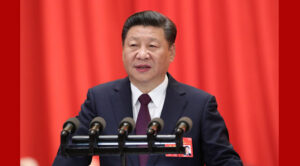
WASHINGTON: The president of China, seeming to cast aside the better part of four millennia of Chinese tradition, declared today that he sees “a new historic juncture in China’s development,” one that clearly calls for his country to flex its global muscles and change the rules that have guided the world since at least World War II.


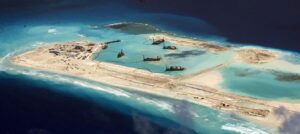
Chinese artificial island in the South China Sea
“China will continue its efforts to safeguard world peace, contribute to global development, and uphold international order,” the increasingly powerful Xi Jinping said at the massive Communist Party Congress, held every five years to rubber-stamp the leadership’s ascendancy and signal its intentions to both the Chinese people and the world. “China will continue to play its part as a major and responsible country, take an active part in reforming and developing the global governance system, and keep contributing Chinese wisdom and strength to global governance.”


Chinese artificial island in the South China Sea

To me, this commitment to “reforming and developing” the rules that govern international behavior is the most intriguing. China has consistently rejected international laws and norms, which it views as tools of the western world, led by the United States. Will this mean that China will press for a wholesale rewriting of fundamental documents such as the Geneva Conventions, continue to reject the ruling of international tribunals if it doesn’t like them (remember the ruling on China’s claims in the South China Sea), and press ahead with the global bribery and corruption that marks so much of its “international development efforts” in Asia, Africa and Latin America?

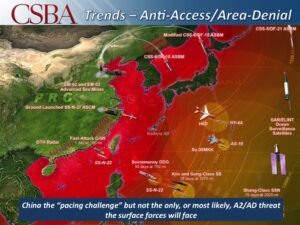
CSBA graphic
CSBA graphic
Chinese weapons ranges (CSBA graphic)

China’s foreign policy will be defined by its “Chinese characteristics,” Xi said in his really long speech, three-and-a-half hours. “China will never pursue development at the expense of others’ interests, but nor will China ever give up its legitimate rights and interests,” he said. Clearly signaling that actions such as those of building fake islands in the South China Sea and challenging the Vietnamese over oil and other economic claims will not cease, the Chinese supreme leader said: “No one should expect China to swallow anything that undermines its interests.”

After its establishment of China’s first overseas military base at Djibouti, the declaration of the almost trillion dollar “Belt and Road Initiative,” and now Xi’s speech today, there seems little doubt the Chinese supreme leader wants his country to boast not regional but global influence, in stark contrast to all but a tiny sliver of its history.


Chinese J-20 fighter prototype
Xi made his comments about international relations just three weeks before President Trump pays his first visit to the world’s fastest rising power. He seemed to offer a rebuke to the Trump administration’s America First approach, saying: “No country can alone address the many challenges facing humanity; no country can afford to retreat into isolation.” By contrast, he said, “China will continue its efforts to safeguard world peace, contribute to global development, and uphold international order.” So, while Trump withdraws from or tries to renegotiate international agreements, alienates allies and focuses his efforts on Pittsburgh, not Paris, Xi seems to be indicating that the Chinese will press ahead, engaging where they can in their own interests.

If you want some idea of just how gay and happy Xi believes the future to be, just read this poster which a colleague at the New Yorker says was posted at the party congress: “Life in China Is Good! Everyday Is Like a Holiday!”

Will the rest of the world enjoy the Chinese holiday or will it pine for the good old days of the Pax Americana?

 Read  more at: Breaking Defense

The Bolsheviks in Beijing


What the Chinese Communist Party Learned From Lenin

By 

his week, after months of factional jockeying, Chinese President Xi Jinping and his colleagues will convene the 19th Chinese Communist Party Congress. At the conclave's end, Xi will walk into a cavernous room in the Great Hall of the People, in Beijing, flanked by China’s new rulers.
Xi and his colleagues head the bureaucracies that manage China's economy, military, propaganda apparatus, and security organs. But on this occasion, they will appear in their most important capacity: as the members of the Politburo’s Standing Committee, China’s top decision-making body. This group will govern China until the next party congress, in 2022.
For party leaders, this week marks another half decade in power. But it will also bring a different anniversary, which Beijing will greet without fanfare. The 19th Party Congress falls on the eve of the centenary of Russia’s Bolshevik Revolution, the movement that led to the creation of the Soviet Union.
China's leaders are attentive students of Soviet history, and the Bolsheviks and the Soviet state they built are both a model and a cautionary tale for the Chinese Communist Party. Memories of the Soviet collapse—the trauma of toppled statues, indigent apparatchiks, and secret archives opened to public scrutiny—steel party leaders’ determination to retain power.
Read more at www.foreignaffairs.com