Thursday, October 26, 2017

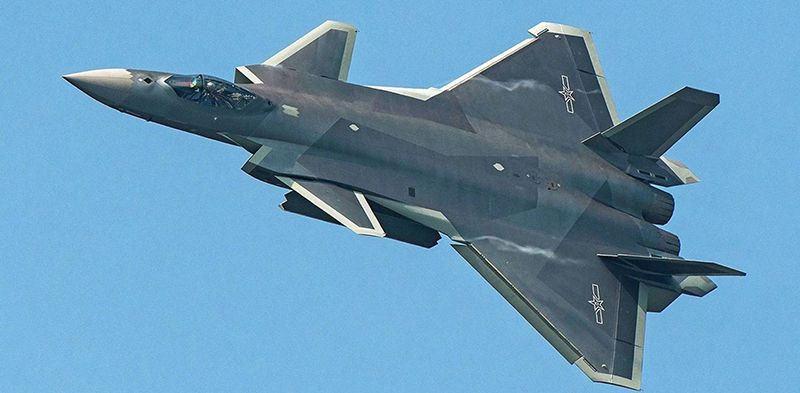
Chinese Stealth Goes Operational, Carrier Program and Export Initiatives Accelerate


By Tom Demerly

China Has Emerged as a Preeminent Global Strategic Super Power: What Does It Mean?

During the past five years China’s defense programs have not accelerated, they have increased by multiples into segments the Chinese had not previously been involved in. The introduction of a developmental aircraft carrier program, the fielding of an operational stealth fighter, the deployment of the world’s longest range ICBM and several new state-sponsored defense programs including tactical aircraft and helicopters intended specifically for export sale signal a parallel emergence of China’s global defense doctrine along with their dominant economic influence.
But what are China’s strategic and tactical air capabilities and, more importantly, what can we theorize about their intentions not only in Asia, but around the world?
China’s new defense and aerospace initiatives are a strategic necessity to provide foundational security for their rising economic influence globally.
Two years ago, in 2015 The International Monetary Fund (IMF) ranked China as the number one economic superpower in the world. That year China surpassed the United States based upon the purchasing power parity of GDP indicator (gross domestic product). The IMF reported that China produced 17% of the world gross domestic product in 2014 passing the U.S. GDP of 16%. China’s increased global influence has inspired low and middle income countries to emulate China’s approach. These Chinese allies now engage in partially state-sponsored rapid economic growth including the Latin American countries, Brazil, Argentina and Columbia as it emerges from a protracted drug war. India and Pakistan are now also aligned with China on several significant defense and economic initiatives.
While the subject of China’s emerging military is vast, there are several standout defense aerospace programs that provide an insight into China’s global motives.

China’s Operational Stealth Fighter: The J-20

China’s Chengdu J-20 stealth fighter has just officially entered active service with the People’s Liberation Army Air Force (PLAAF): “China’s latest J-20 stealth fighter has been officially commissioned into military service, Ministry of National Defense spokesperson Wu Qian told global media in a September 28, 2017 press release on the Xinhua.net and the official state defense media website.
Analysts suggest the J-20 is likely a medium-long range interceptor roughly analogous to the interceptor role of legacy aircraft like Russia’s older MiG-25 Foxbat, albeit much more sophisticated, and comparable to a Gen. 5 fighter.
There have also been comparisons to the U.S. F-22 Raptor, although the F-22 has emerged in combat in Syria as a precision strike low-observable aircraft in addition to its air superiority role. Western observers have suggested the primary low-observable capability of the J-20 is from the front of the aircraft, but perhaps not at other aspects, suggesting the J-20 is optimized for the interceptor role at least initially.
At different times, both in 2016 and 2017, there were unconfirmed reports that China may sell the J-20 to Pakistan in what would be the first-ever sale of a stealth air superiority specific Gen 5 aircraft in the export market (the multinational F-35 is described as a multirole Joint Strike Fighter, not exclusively as an air superiority interceptor like the J-20 or the U.S. F-22, which has not been exported outside the U.S.
Given this and more information about the J-20 it can be reasonably suggested that this aircraft is intended primarily for defense of Chinese air space and, if exported, some of its border allies. Sharing air defense with friendly border countries makes sense since China shares a border with a staggering 14 different countries. The U.S. only borders 2.

Read more at https://theaviationist.com/2017/10/25/chinese-stealth-goes-operational-carrier-program-and-export-initiatives-accelerate/#u24CMxrI7oU4G5A5.99

Wednesday, October 25, 2017

Oil Quality Issues Could Bankrupt Venezuela

By Nick Cunningham 

Venezuela

The next few weeks for Venezuela will be crucial, as it could struggle to meet a huge stack of debt payments. Reports that the nation’s oil production is experiencing deteriorating quality raises a new cause for concern for the crumbling South American nation.
Venezuela’s state-owned oil company PDVSA is reportedly shipping crude oil with growing quality issues. Reuters reported that its oil shipments are “soiled with high levels of water, salt or metals that can cause problems for refineries”. It’s a troubling situation for an oil company already suffering from a steep drop in output.
The quality problem is very much related to the country’s economic crisis. Without cash, PDVSA is struggling to obtain the proper chemicals to treat its oil, or pay for equipment and upkeep to maintain quality. As a result, PDVSA has had to shut down operations, or throttle back on production. “We’re refitting chemical injection points, recouping pumps and storage tanks,” one PDVSA worker told Reuters. “But without chemicals, we can’t do anything.”
The oil company has been shipping crude that is apparently causing problems for refiners around the world. According to Reuters, that has led to complaints and even cancellations of purchases. Phillips 66, a U.S. refiner, cancelled at least eight cargoes in the first half of the year due to inferior quality. It also demanded discounts for other shipments. Refiners in India and China have also lodged complaints.
The sales cancellation poses a serious financial threat to a company and country already wallowing in a horrific economic crisis. For example, the cancelled shipments were carrying oil representing $200 million in value, according to Reuters estimates. PDVSA is the only lifeline for the Venezuelan state, so reports that the one source of revenue keeping the country somewhat afloat is not only declining but is now exhibiting declining quality is alarming.
Output is falling, cash is drying up and oil workers have fled the country because of food shortages and violence.
The problem for PDVSA is compounded by the fact that a few months ago the Trump administration slapped sanctions on new financial arrangements with the oil company, prohibiting PDVSA from engaging with U.S. banks to restructure debt. The measures also add a new level of red tape for U.S. refiners who do business with PDVSA. Because of the new pressure from Washington, refiners are starting to look elsewhere for their crude. PBF Energy, the fifth largest U.S. refiner and regular PDVSA customer, has reportedly halted direct purchases from the Venezuelan oil company.

Read more at: Oilprice.com

The 5 Countries That Could Push Oil Prices Up

By Nick Cunningham - Oct 23, 2017,

Oil

Oil prices appear to be stuck in the $50s per barrel, but that doesn’t mean there aren’t serious supply risks to the market.
An unexpected disruption could occur at any moment, as has happened in the past, leading to a sudden and sharp jump in prices. Geopolitical tension has been largely irrelevant since the collapse of oil prices in 2014, but it’s making a return now that cracks have emerged in some key oil-producing nations. The threat of an outage will carry more weight as the oil market tightens.
"The 'Fragile Five' petrostates—Iran, Iraq, Libya, Nigeria and Venezuela—continue to see supply disruption potential, with northern Iraq crude exports at risk due to an escalation of tensions between the (Kurdistan Regional Government), Baghdad and Turkey, while the United States has decertified the 2015 Iran nuclear deal," U.S. bank Citi said.
Indeed, five prominent oil-producing nations are beset with challenges, for varying reasons, all of which could spring a surprise on the oil market without any advanced notice.
Iraq. The most near-term supply risk comes from Iraq. The surprise seizure of Kirkuk’s oil fields by the Iraqi government has already disrupted some oil shipments. The Bai Hassan and Avana oil fields near Kirkuk remained shut as of October 19, keeping at least 275,000 bpd offline. The outages are expected to be temporary; a source told Reuters last week that they’re seeking certain equipment to bring the fields back online. An agent at the Turkish port of Ceyhan—the destination for Iraq’s northern oil exports—told Bloomberg that flows fell to 196,000 bpd as of October 19, implying an outage of about 400,000 bpd. Iraq represents the most obvious near-term threat to global supplies, but because the bulk of the country’s output is located in the south, far from the unrest, the potential outage is likely capped at 600,000 bpd, and would probably be temporary.
Iran. This one’s probably the biggest question mark on this list, and is in a much stronger position than its more fragile peers. The danger to Iran is a return of U.S. sanctions, which are by no means a given. Even then, it’s unclear if the U.S. has the ability to curtail Iranian oil exports. It might scare away new investment, but even U.S. Secretary of State Rex Tillerson went to lengths recently to assure European officials that it wouldn’t block business between European companies and Iran. Goldman Sachs estimates that in a relatively worst-case scenario of a return of U.S. sanctions, a few hundred thousand barrels of oil exports would be at risk—not the more than 1 mb/d of disrupted exports due to sanctions before the nuclear deal. At this point, though, potential outages are too hypothetical to be taken seriously. Iran probably won’t pose a supply risk to the market, at least not this year.
Libya. The North African OPEC member was exempted from the OPEC deal, and for much of the past year has represented a downside risk to oil prices, not an upside one. That is because it has nearly tripled its output from about 300,000 bpd in August 2016 up to about 850,000 bpd currently, down a bit from a recent peak at over 1 mb/d. But damage to some export terminals likely means that near-term production has a ceiling at about 1.25 mb/d, meaning Libya won’t be able to bring output back to pre-war levels of 1.6 mb/d. But because current output is now taken for granted and already baked into global pricing calculations, Libya now represents a supply risk to the market because an outage is entirely realistic due to ongoing instability. The country is nearing its ceiling for production, while there’s plenty of room for it to fall back.
Nigeria. The story here is similar to Libya. It was also exempted from the cuts because violence and instability previously knocked a sizable portion of output offline. But Libya’s restoration of output coincided with a similar reduction in violence in the Niger Delta. A ceasefire brought calm for much of the past year, allowing production to rebound from a low point of 1.2 mb/d last year, back up to 1.8 mb/d currently. Potential for further output gains is probably limited, not least because the country promised to limit production when it hit 1.8 mb/d. Meanwhile, peace in the Niger Delta remains fragile, and reports that militants have grown frustrated with the pace of talks with the government raises concerns about a return to violence. The rebound in Nigerian production is not assured.
Venezuela. The unfolding implosion of Venezuela almost ensures that more of the country’s oil production will erode, perhaps at a quickening pace. As of September, Venezuela only produced 1.89 mb/d, down from 3.2 mb/d in the late 1990s, but also down from nearly 2.4 mb/d as recently as 2015. Without cash, state-owned PDVSA can’t invest in new production and can’t even invest in maintenance to keep existing production from falling. Reports have surfaced suggesting that even the oil that is produced is suffering from declining quality, as PDVSA doesn’t have the means to properly treat its heavy crude. Worse, with huge debt payments coming due in the next few weeks, a debt default is possible. All of this adds up to a further deterioration in the country’s oil output.
By Nick Cunningham for Oilprice.com