Showing posts with label Ukraine. Show all posts

Saturday, March 11, 2023

Tackling the Underwater Threat: How Ukraine Can Combat Russian Submarines

 Dr Sidharth Kaushal and Dr Kevin Rowland  

7 March 2023 


Given that building anti-submarine warfare capabilities along Western lines would require significant time and resources, how can Ukraine best counter the Russian submarine threat?


One of the signal successes of the Ukrainian armed forces has been denying the Russian Black Sea Fleet’s surface vessels the ability to operate in close proximity to Ukrainian shores. The successful attack on the fleet’s flagship, the Moskva, with indigenous Neptune anti-ship cruise missiles and the subsequent Russian defeat at Snake Island denied the fleet the air cover it needs to be able to operate in range of an increasingly credible Ukrainian anti-ship missile threat. As such, it may prove increasingly difficult for Russia to enforce a renewed surface blockade of Ukraine if it decides that inflicting economic harm is important – a likely assumption if the war of attrition continues over the longer term.


That being said, Russia does have other options with which to menace Ukraine’s maritime economy. The risk posed by naval mines represents one vector; another is the use of submarines, which have not featured significantly in the conflict thus far. The Black Sea Fleet’s force of four Project 636 (Kilo) and Project 877 (Improved Kilo) submarines have not been used in a blockading role to date, acting primarily as a launch platform for 3M-14 Kalibr cruise missiles. However, if Russia did decide to use them in this capacity, it would raise new challenges for Ukraine’s sea denial strategy, which thus far has had to contend primarily with the (comparatively) easy task of anti-surface warfare. The skills and capabilities needed for Ukraine to conduct anti-submarine warfare (ASW) along Western lines would be time-consuming and expensive to generate, and are unlikely to be acquired in the foreseeable future, begging the question of how to ‘do’ ASW on a shoestring.


The Relevance of the Black Sea Fleet’s Kilo-Class Submarines

In the immediate term, and for good reason, Ukraine’s priorities are likely to remain primarily land-focused. However, should the conflict reach a point of enduring, frozen stalemate, Russia may shift its military focus to wearing down the Ukrainian economy, which has already seen a 30% reduction in GDP. To an extent, this has been visible in the air and missile campaign witnessed over the winter. Moreover, it would follow a pattern of how belligerents attempt to secure a strategic breakthrough when a tactical battlefield breakthrough seems unlikely – with precedents such as the Iran–Iraq tanker war and the British blockade of Germany during the First World War.


To an extent, one might argue that Moscow does not need military force to inflict a de facto blockade – simply declaring that it has pulled out of the grain deal, for example, would likely cause insurance rates to spike to exorbitant levels. However, two alternative scenarios might be considered.


First, Moscow may wish to drive a spike in insurance costs without paying the diplomatic price for pulling out of the grain deal. A deniable attack could be facilitated by the Kilo-class submarines. The boats can clandestinely lay up to 24 naval mines each during a single sortie. A direct torpedo attack would be more audacious, but it is worth recalling the time it took to attribute North Korea’s sinking of the South Korean vessel Cheonan in 2010 – four months – by which time the initial international outrage had abated. Attacking a vessel carrying a volatile substance such as ammonium nitrite might offer a level of deniability which, however implausible, could preclude unambiguous attribution. To consider the impact of such action, we might consider that in 2019, insurance rates in the Strait of Hormuz rose tenfold after Iran’s limpet mine attacks – even though a convoy system was put in place.


Second, the Black Sea Fleet’s submarines are an important launch platform for Russian cruise missiles such as the 3M-14 Kalibr, which – according to some experts – came close to delivering a death blow to Ukraine’s energy grid this winter. Any effort to maintain Ukraine’s viability in the long term will depend on the ability of its economy to at least partially recover from the impact of war, and open sea lines of communication will be crucial. The Black Sea Fleet’s submarines thus represent a clear and present challenge which the Ukrainian navy will need to resolve.


The Challenge of ASW

There are, however, be a number of issues that will preclude any effort to transpose a Western approach to ASW to Ukraine in the medium term. First, the platforms involved are too expensive and small in number to be gifted. Assets such as the P-8 maritime patrol aircraft or specialist ASW frigates are unlikely to be transferred, and the Ukrainian armed forces would struggle to crew, operate and protect them in any case.


ASW is an inherently skill-intensive task. Training an aviator on a Royal Navy Merlin helicopter, for example, takes at least 11 months before they can be integrated into frontline squadrons, and training pipelines everywhere are well known to be at capacity already. Training times for sonar operators are similarly long. Moreover, this excludes the challenge of integrating personnel into coherent units that can operate in tandem with one another. Though the Ukrainian navy had 11,000 personnel in its service when the war began, the fact that it had lost much of its fleet after 2014 – as well as an understandable focus on events on land – raises questions about the speed at which necessary competencies can be built, or rebuilt, within the force.


Finally, the maintenance of the platforms needed to operate an ASW barrier along Western lines would strain capacity at Ukrainian facilities, particularly if they remain under bombardment.


As such, a solution to the challenge of ASW – at least in the near term – needs to be developed along fundamentally different lines from traditional, Western approaches.


Begin with the End State, Not the Platform

There could, however, be relatively cost-effective solutions to the challenges that Ukraine faces. These could be built on the principle that harassment, rather than sea denial, should be the immediate Ukrainian goal. It is not necessary to destroy Russia’s submarines if they can be prevented from doing operationally useful work.


As a working hypothesis, it is reasonable to assume that Russian sabotage or interdiction of shipping to Ukraine is likely to occur within or close to Ukraine’s exclusive economic zone in the northern Black Sea, both to signal intent and because damaging vessels in a warzone is likely to be less contentious to the international community than sinking them well within international waters. If this is the case, the geography of the northern Black Sea offers partial solutions. The average depth of the area – 200 metres – is less than the 240-metre depth at which the Kilo generally operates, meaning that navigation and operation will be more difficult for submarines. This is not to say that it is impossible, and some parts exceed the average depth. However, submarines operating in the northern Black Sea do so at increased risk of collision, grounding and detection. The passage of submarines can be made even more risky by seeding the areas within which they can operate with remotely activated mines such as the US Hammerhead. Because these mines can be remotely activated, they are compatible with international law, and the fact that they can be programmed to seek specific magnetic anomalies aids against target misidentification. This would force the Kilos to operate in even shallower waters, increasing their risk even further.


Beyond canalising submarines through mines, Ukraine could use uncrewed capabilities to harass them further. For example, UAVs operating dipping sonobuoys and lightweight torpedoes could be utilised in an ASW role – an avenue that multiple navies are pursuing, albeit experimentally. While accurate detection by a UAV thus equipped may not be certain, a responsible submarine commander would have to take evasive action if he or she detected a pinging sonar, potentially disrupting firing solutions, affecting the vessel’s endurance, or even putting it in navigational danger. The perception that a UAV is armed and primed to attack could be exacerbated if some UAVs were equipped with munitions while many more were equipped with decoys that simulated the acoustic profile of an attack. We might think of the impact that the US Navy’s Julie Jezebel sonobuoys – which simulated the noise profile of a depth charge – had on Soviet submariners during the Cuban missile crisis.


Russian submariners’ perceptions of operational risks could also be compounded if Ukraine were to take possession of even a very limited number of ASW helicopters. Finally, the presence of NATO or other intelligence gathering aircraft, including P-8s, over the Black Sea would force Russian commanders to consider the possibility that Ukrainian assets were being cued, which – whether true or not – could be reinforced by conducting UAV flights at times at which the aircraft are present. Ultimately, all of these actions would raise the perceived risk for Russian operators and slow the rate and tempo of their activity.


Conclusions

There are no perfect immediate-term solutions to the submarine challenge. In the long term, after the war’s conclusion, Ukraine might well consider meeting the goals set out in its 2019 naval strategy, including rebuilding a surface fleet capable of limited sea control in peacetime, as well as prosecuting ASW missions near its shores and other sea denial missions. In the meantime, while the ideal of denying areas to Russian submarines is unlikely to be achieved, Ukraine can impose upon the Kilos and their operators a set of conditions which – though they may not end the submarine threat – will strain both vessels and crews. The immediate goal guiding Ukrainian ASW, then, should be harassment.


The views expressed in this Commentary are the authors’, and do not represent those of RUSI or any other institution.


Read more here.

Friday, September 16, 2022

Russian Offensive Campaign Assessment, September 15 by ISW

 Kateryna Stepanenko, Katherine Lawlor, Grace Mappes, George Barros, and Frederick W. Kagan

September 15, 9:30 pm ET


Click here to see ISW’s interactive map of the Russian invasion of Ukraine. This map is updated daily alongside the static maps present in this report.

Ukrainian forces are continuing counteroffensive operations in eastern Ukraine, increasingly pressuring Russian positions and logistics lines in eastern Kharkiv, northern Luhansk, and eastern Donetsk oblasts. Russian sources reported that Ukrainian forces are continuing ground operations southwest of Izyum, near Lyman, and on the east bank of the Oskil River, reportedly compelling Russian forces to withdraw from some areas in eastern Ukraine and reinforce others.[1] Russian forces in eastern Ukraine will likely struggle to hold their defensive lines if Ukrainian forces continue to push farther east.

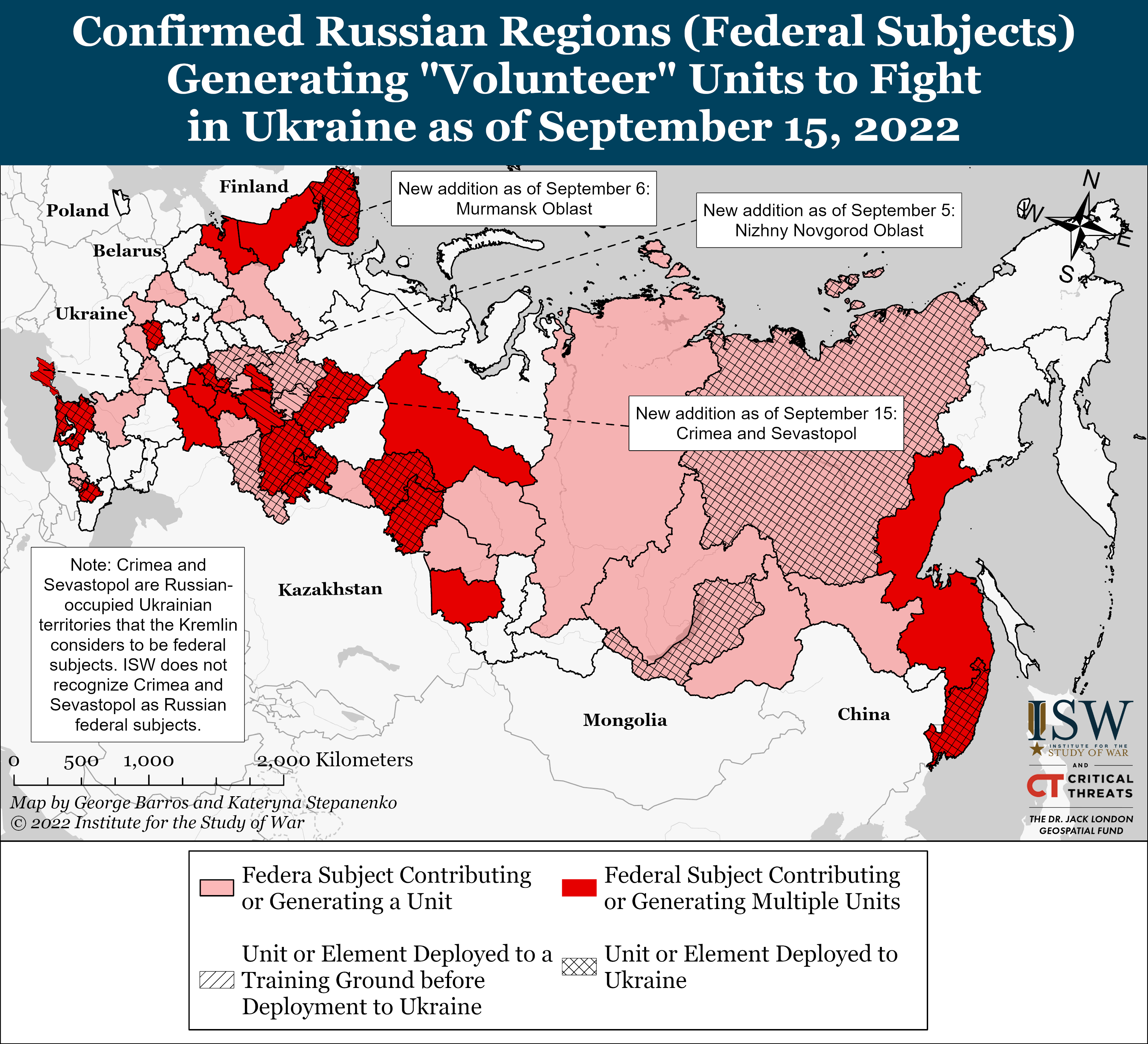
The Kremlin is responding to the defeat around Kharkiv Oblast by doubling down on crypto-mobilization rather than setting conditions for general mobilization. Chechen leader Ramzan Kadyrov called on all federal subjects to initiate “self-mobilization” and not wait on the Kremlin to declare martial law.[2] Kadyrov claimed that each federal subject must prove its readiness to help Russia by recruiting at least 1,000 servicemen instead of delivering speeches and conducting fruitless public events. Russian propagandist Margarita Simonyan echoed the need for Russians to volunteer to join the war effort, and several loyalist Russian governors publicly supported Kadyrov’s speech.[3] The Russian-appointed head of occupied Crimea, Sergey Aksyonov, announced the formation of two volunteer battalions on the peninsula in support of Kadyrov’s calls.[4]

The defeat around Kharkiv Oblast prompted the Kremlin to announce a Russia-wide recruitment campaign. Kremlin officials and state media had not previously made country-wide recruitment calls but had instead tasked local officials and outlets to generate forces ostensibly on their own initiative. Kremlin Spokesperson Dmitry Peskov vaguely welcomed the creation of the battalions on July 12, while 47 loyalist federal subjects advertised and funded the regional volunteer battalion recruitment campaign.[5] A prominent Russian milblogger and a supporter of general mobilization praised officials such as Kadyrov for taking the recruitment campaign from the ineffective Russian Ministry of Defense; this recruitment revamp is likely to secure more support for the Kremlin among nationalist figures who are increasingly critical of the Russian MoD, even if the drive does not generate large numbers of combat-effective troops.[6]

The Kremlin has likely abandoned its efforts to shield select federal subjects from recruitment drives, which may increase social tensions. ISW has previously reported that the Kremlin attempted to shield Moscow City residents from reports of the formation of the Moscow-based “Sobyaninsky Polk” volunteer regiment.[7]  Russian opposition outlet The Insider noted that several groups in the republics of Buryatia, Kalmykia, Tyva, and Yakytia (Republic of Sakha) are publicly opposed to the Kremlin's emphasis on recruitment on an ethnic basis.[8] Simonyan’s statement about “self-mobilization” prompted numerous negative comments among Russians calling on Russian oligarchs to pay for and fight in the war.[9]

The Kremlin has almost certainly drained a large proportion of the forces originally stationed in Russian bases in former Soviet states since Russia’s full-scale invasion of Ukraine began in February, likely weakening Russian influence in those states. A Radio Free Europe / Radio Liberty (RFE/RL) investigation reported on September 14 that the Russian military has already deployed approximately 1500 Russian personnel from Russia’s 201st Military Base in Dushanbe, Tajikistan, to Ukraine since the full-scale invasion began and plans to deploy 600 more personnel from facilities in Dushanbe and Bokhatar, a southern Tajik city, in the future.[10] RFE/RL additionally reported on September 13 that Russia has likely redeployed approximately 300 Tuvan troops from the Russian Kant Air Base in Kyrgyzstan to fight in Ukraine at varying points since late 2021.[11]

The withdrawals from the Central Asian states are noteworthy in the context of border clashes between Kyrgyzstan and Tajikistan. Tajik and Kyrgyz border guards exchanged fire in three separate incidents on September 14, killing at least two people.[12] The uptick in violence between Tajikistan and Kyrgyzstan, both of which are members of the Russian-controlled Collective Security Treaty Organization (CSTO), comes alongside renewed aggression by Azerbaijan against CSTO member state Armenia. Russian forces also withdrew 800 personnel from Armenia early in the war to replenish losses in Ukraine, as ISW has previously reported.[13]

Key Takeaways

  • Ukrainian forces continued counteroffensive operations in eastern Ukraine.
  • The Kremlin is responding to the defeat around Kharkiv Oblast by doubling down on crypto-mobilization, rather than setting conditions for general mobilization.
  • The Kremlin has almost certainly drained a large proportion of the forces originally at Russian bases in former Soviet states since Russia’s full-scale invasion of Ukraine began in February, likely weakening Russian influence in those states.
  • Russian and Ukrainian sources reported Ukrainian ground attacks northwest of Kharkiv City, near the Ukrainian bridgehead over the Inhulets River, and south of the Kherson-Dnipropetrovsk Oblast border.
  • Russian-appointed occupation officials and milbloggers claimed that Ukrainian forces conducted a landing at the Kinsburn Spit (a narrow peninsula of the Crimean Peninsula).
  • Russian forces conducted limited ground assaults and are reinforcing positions on the Eastern Axis.
  • The Russian proxy Donetsk People’s Republic (DNR) is likely attempting to stop its administrators from fleeing ahead of the Ukrainian counteroffensive, demonstrating the bureaucratic fragility of the DNR.

We do not report in detail on Russian war crimes because those activities are well-covered in Western media and do not directly affect the military operations we are assessing and forecasting. We will continue to evaluate and report on the effects of these criminal activities on the Ukrainian military and population and specifically on combat in Ukrainian urban areas. We utterly condemn these Russian violations of the laws of armed conflict, Geneva Conventions, and humanity even though we do not describe them in these reports.

  • Ukrainian Counteroffensives—Southern and Eastern Ukraine
  • Russian Main Effort—Eastern Ukraine (comprised of one subordinate and two supporting efforts);
  • Russian Subordinate Main Effort—Capture the entirety of Donetsk Oblast
  • Russian Supporting Effort—Southern Axis
  • Russian Mobilization and Force Generation Efforts
  • Activities in Russian-occupied Areas

Ukrainian Counteroffensives (Ukrainian efforts to liberate Russian-occupied territories)

Eastern Ukraine: (Vovchansk-Kupyansk-Izyum-Lyman Line)

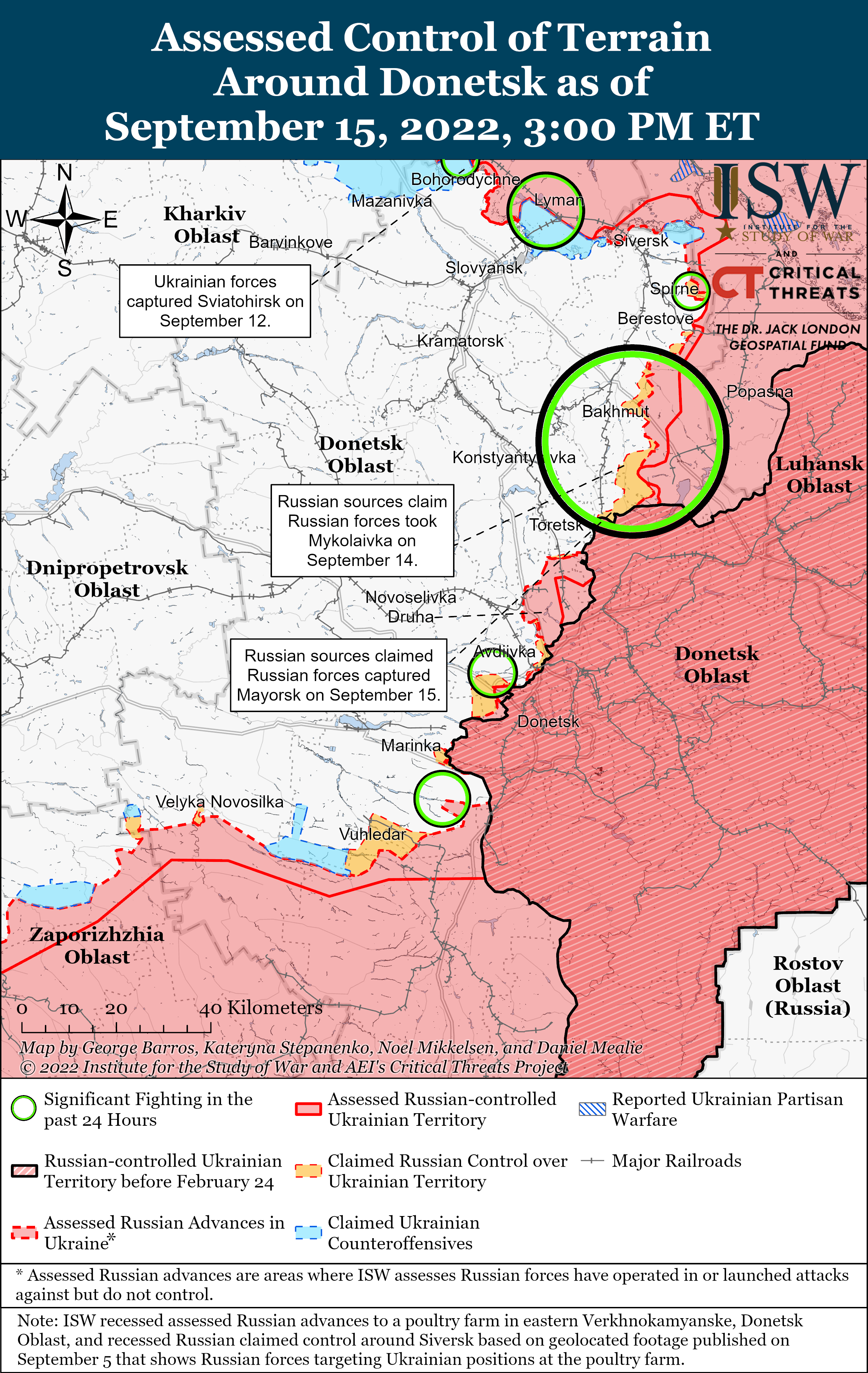
Ukrainian forces continued counteroffensive operations in eastern Ukraine, setting conditions to drive deeper into the Russian rear in eastern Kharkiv and western Luhansk oblasts. A Russian source claimed that Ukrainian forces expelled Russian forces from Sosnove on the north bank of the Siverskyi Donets River and are fortifying positions at the settlement.[14] The source also reported that Russian forces may have pulled out from Studenok immediately west of Sosnove to avoid encirclement.[15] Official Russian and Ukrainian sources reported that Russian forces reinforced Russian positions in Lyman.[16] The Ukrainian General Staff reported that the heavily reduced remnants of the Luhansk People’s Republic (LNR) 2nd Army Corps 202nd and 204th Motorized Rifle Regiments were disbanded into reserves, possibly meaning that the remnants of these reduced elements reinforced the Russian Combat Army Reserve (BARS) elements fighting in Lyman.[17]

Ukrainian forces are reportedly advancing across the Oskil River in northern Kharkiv Oblast. A Russian source claimed that Ukrainian forces are establishing bases and artillery positions throughout Kharkiv Oblast, including emplacing artillery in Hryanykivka on the east bank of the Oskil River near the R79 highway.[18] A confirmed Ukrainian position in Hryanykivka would indicate that the Russian frontline east of the Oskil River is weak and/or that Russian forces’ lines in this area are farther east of the Oskil River than previously assessed.  ISW will continue collecting and reconciling data to refine our control of terrain assessment. A Russian source reported that Ukrainian sabotage and reconnaissance groups occasionally cross the Oskil River in unspecified areas.[19]

Ukrainian forces continued operations to disrupt Russian logistics in eastern Ukraine and pin Russian forces away from the frontlines. Ukrainian forces reportedly struck rear areas in occupied Luhansk Oblast, including Lysychansk, Svitlodarsk, Perevalsk, and Kadiivka, all situated along major Russian GLOCs.[20] Imagery shows the aftermath of a Ukrainian strike on a Russian base in Lysychansk.[21] Russian and Ukrainian sources engaged in artillery duels across the Kharkiv-Belgorod Oblast border.[22]

Southern Ukraine: (Kherson Oblast)

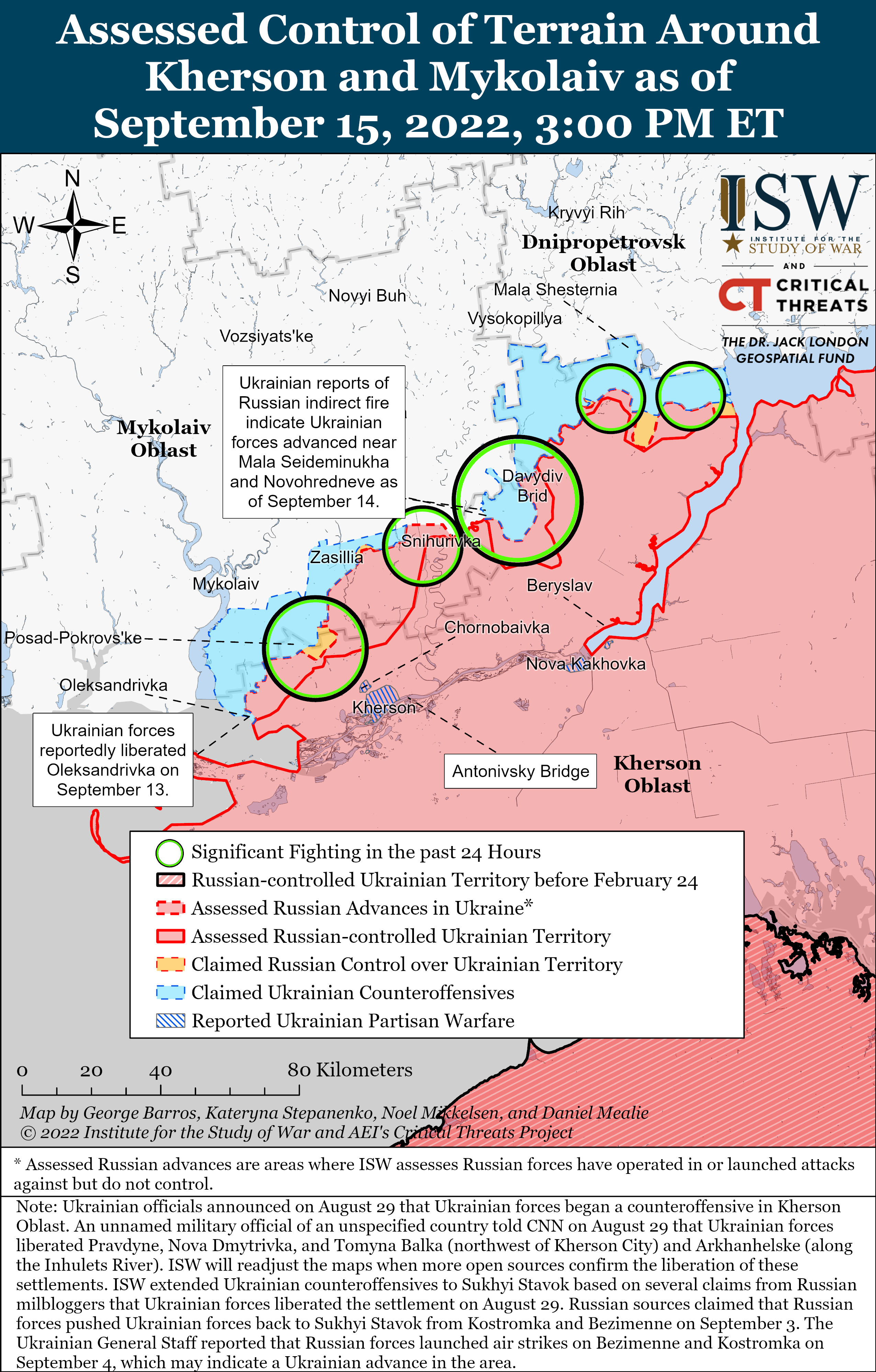
Ukrainian military officials are continuing their operational silence regarding the progress of the southern counteroffensive, noting that Ukrainian forces are continuing to improve their tactical positions and are engaged in positional battles.[23] Ukrainian local sources stated that there is no official confirmation that Ukrainian forces have liberated Kyselivka northwest of Kherson City but noted receiving local reports that Russian forces are mining all of the roads in the settlement.[24] Ukrainian officials did not report changes in Russian troop composition, but social media footage showed a Tuva Oblast flag in Beryslav, which likely indicates that Russian forces are continuing to reinforce northern Kherson Oblast with regionally formed volunteer units.[25] Conventional Russian military units typically do not fly republic or federal subject flags.

Ukrainian military officials stated that Ukrainian forces are continuing their interdiction campaign, targeting Russian ground lines of communication (GLOCs) across the Inhulets and Dnipro Rivers.[26] Ukrainian military officials noted that Russian forces are continuing to transfer equipment across the Dnipro River, however.[27] Ukrainian forces reportedly struck areas of Russian manpower and equipment concentrations in the Kherson City suburbs and in Krynychanka (about 21km southeast of the Ukrainian bridgehead over the Inhulets River).[28] The Ukrainian Southern Operational Command noted that Ukrainian forces damaged Russian ammunition depots in Sadove (about 15km southwest of Snihurivka) and Mykolaiv and Kherson raions, and struck the unmanned aerial vehicle (UAV) control center in Komyshany, northwest of Kherson City.[29] Ukraine’s Department of Strategic Communications (StratCom) reported that Ukrainian forces destroyed a Russian military base in Nova Kakhovka, and local footage and reports corroborated StratCom’s information.[30] Other social media reports noted Ukrainian strikes on Russian positions in Oleshky, on the left bank of the Dnipro River.[31]

Ukrainian and Russian sources indicated three areas of kinetic activity on September 15: northwest of Kherson City, near the Ukrainian bridgehead over the Inhulets River, and south of the Kherson-Dnipropetrovsk Oblast border west of Vysokopillya. A Russian milblogger claimed that one Ukrainian reconnaissance and sabotage group drove down 25km southeast of the bridgehead to Charivne in a car without encountering any obstacles.[32] The milblogger added that Russian shelling decreased in Sukhyi Stavok (about 12km southeast of the bridgehead) and that Ukrainians are operating helicopters in the area, which may indicate that Russian forces have pulled back further from the bridgehead area. The milblogger noted that Russian forces continue to repel Ukrainian counterattacks on Davydiv Brid on the T2207 highway. The Ukrainian Southern Operational Command reported that Ukrainian forces repelled Russian assaults from Arhanhelske on Ivanivka (west of Vysokopillya), while Russian milbloggers claimed that Russian airborne troops repelled Ukrainian counterattacks on Kostyrka and Novopetrivka.[33] Kherson Oblast Head Yaroslav Yanushevych stated that Ukrainian forces conducted evacuations from Myrolyubivka (southeast of Vysokopillya), which could indicate that Ukrainian forces have advanced to the settlement.[34] Both the Russian Defense Ministry and the Ukrainian General Staff reported that Russian forces launched missile strikes at Ukrainian positions on the Kherson Oblast border.[35]

Russian-appointed occupation officials and milbloggers claimed that Ukrainian forces conducted a landing at the Kinsburn Spit (a narrow peninsula of the Crimean Peninsula southwest of Kherson City) on September 14, but offered differing accounts. Several milbloggers amplified the claims of a single source that suggested Ukrainian forces conducted an unsuccessful amphibious landing at the Kinsburn Spit with five boats. The source also claimed that there was an unconfirmed report of a heliborne landing at the Iron Port in Lazurne, about 60km southwest of Kherson City.[36] Deputy Head of the Russian occupation administration in Kherson Oblast Kirill Stremousov claimed that Russian forces repelled the attempted landing and killed over 120 Ukrainian airborne troops at the Kinsburn Spit.[37] Another milblogger criticized Stremousov and pointed out that his sources within Russian units in the area did not witness or repel any Ukrainian landing attempts and that Stremousov did not present any visual evidence supporting his claim.[38]


Russian Main Effort—Eastern Ukraine

Russian Subordinate Main Effort—Donetsk Oblast (Russian objective: Capture the entirety of Donetsk Oblast, the claimed territory of Russia’s proxies in Donbas)

Russian forces conducted limited ground assaults across the Eastern Axis and continued routine fire along the line of contact on September 15.[39] Both Ukrainian and Russian official sources confirmed fighting in Spirne (east of Siversk) and Mayorsk (south of Bakhmut).[40] Russian sources claimed that Russian forces captured Mayorsk, though ISW cannot verify this claim.[41] The Ukrainian General Staff also reported that Ukrainian forces repelled Russian ground assaults against Mayorsk, southeast of Bakhmut, and southwest of Donetsk City.[42]

Russian forces are reinforcing positions along the Eastern Axis, likely due to extensive combat losses. The Ukrainian General Staff reported that Russian forces are moving reserves from 3rd Army Corps volunteer battalions and remnants of units previously operating in Kharkiv Oblast to reinforce the Donetsk and Zaporizhia Oblast frontlines.[43] The Ukrainian General Staff also reported that the Russian 137th Airborne Regiment (subordinate to the 106th Airborne Division) sustained significant combat losses in the Bakhmut area and cannot continue combat operations without additional unspecified measures (likely meaning reconstitution).[44]

Supporting EffortSouthern Axis (Russian objective: Maintain frontline positions and secure rear areas against Ukrainian strikes)

Russian forces continued to strike Ukrainian hydraulic structures in Kryvyi Rih and other infrastructure in Ukraine on September 15. Dnipropetrovsk Oblast officials reported that Russian forces again targeted unspecified hydraulic structures in Kryvyi Rih, and Russian sources published footage of smoke claiming that Russian strikes damaged an unspecified dam on the Inhulets River on September 15.[45] Russian forces are likely continuing to strike Ukrainian dams on the Inhulets River to raise flood levels in an effort to disrupt the Ukrainian bridgehead over the river in northern Kherson Oblast and threaten Ukrainian logistics lines in the same way that Ukrainian forces are targeting Russian crossings of the Dnipro River.[46] Russian milbloggers amplified footage of large-scale explosions in the cities of Uman, Zaporizhia, and Vinnytsia, as well as in Odesa Oblast.[47] Russian forces also launched an Onyx cruise missile from a Bastion coastal missile complex and a Kh-59 missile fired from an Su-35 aircraft at an open area in Mykolaiv Oblast.[48] Social media users reported witnessing the activation of Russian air defense systems in Yevpatoria, Crimea.[49]

Mobilization and Force Generation Efforts (Russian objective: Expand combat power without conducting general mobilization)

Russian military leadership continues to pull newly-mobilized forces from every possible source but is unlikely to be able to meaningfully increase Russian combat power with those forces. The Ukrainian General Staff reported on September 15 that the Russian government lifted restrictions on conscription for large families, suggesting that multiple sons from the same family could be forced to fight in Ukraine.[50] The Ukrainian mayor of Melitopol, Ivan Fedorov, reported on September 14 that Russian forces are promoting Russian military service in occupied territories such as Melitopol.[51] Forcibly or even willingly-mobilized Ukrainian civilians without military experience who are ordered to fight their better-trained countrymen are unlikely to significantly enhance Russian combat power in Ukraine.

The Russian Ministry of Defense announced on September 15 that the Russian Military Construction Complex is building a new, modern “military town” in Sernovodskoye in the Chechen Republic.[52] The town will reportedly contain over 50 facilities to accommodate Chechnya-based units.

Activity in Russian-occupied Areas (Russian objective: consolidate administrative control of occupied areas; set conditions for potential annexation into the Russian Federation or some other future political arrangement of Moscow’s choosing)

The Russian proxy Donetsk People’s Republic (DNR) is likely attempting to stop its administrators from fleeing ahead of the Ukrainian counteroffensive, demonstrating the bureaucratic fragility of the DNR. The DNR’s State Defense Committee extended one-time injury payments of 3 million rubles and one-time death payments of 5 million rubles to the families of officers, civil servants, and employees of the DNR’s Ministry of Emergency Situations killed in the line of work, the first time ISW has observed DNR civil servants being promised payment in the event of their injury or death in the war.[53] The DNR is likely attempting to incentivize its employees to remain in place to prevent a collapse in local governance as Ukrainian forces advance. Russian occupation forces have struggled to staff local administrations in occupied Ukrainian territory since the invasion began due to a lack of willing Ukrainian collaborators and competent bureaucrats.

Note: ISW does not receive any classified material from any source, uses only publicly available information, and draws extensively on Russian, Ukrainian, and Western reporting and social media as well as commercially available satellite imagery and other geospatial data as the basis for these reports. References to all sources used are provided in the endnotes of each update. 


[1] https://t.me/rybar/38811; https://t.me/rybar/38790; https://t.me/rybar/38840; https://t.me/nm_dnr/9013; https://t.me/NeoficialniyBeZsonoV/17672; https://t.me/epoddubny/12301; https://t.me/sashakots/35673; https://t.me/sashakots/35659; https://t.me/sashakots/35666

[2] https://t.me/kommunist/9450; https://t.me/RKadyrov_95/2822

[3] https://t.me/margaritasimonyan/12050; https://ura dot news/news/1052587297

[4] https://t.me/Aksenov82/1469; https://t.me/kommunist/9459; https://t.me/NeoficialniyBeZsonoV/17678; https://eadaily dot com/ru/news/2022/09/15/v-krymu-tozhe-nachali-formirovat-dobrovolcheskie-batalony

[5] https://www.understandingwar.org/backgrounder/russian-offensive-campaign-assessment-august-28; https://tass dot com/politics/1478839

[6] https://t.me/strelkovii/3249

[7] https://www.understandingwar.org/backgrounder/russian-offensive-campaign-assessment-august-24

[8] https://theins dot ru/politika/254329

[9] https://24tv dot ua/ru/simonjan-sdelala-novoe-zajavlenie-zovet-rossijan-sobirat-dengi_n2157987

[10] https://www.rferl.org/a/russia-troops-tajik-base-redeployed-ukraine/32033791.html

[11] https://www.rferl.org/a/russia-kyrgyzstan-base-troops-redeployed/32031647.html

[12] https://www.reuters.com/world/asia-pacific/world/fresh-clash-erupts-between-kyrgyz-tajik-border-guards-2022-09-14/

[13] https://understandingwar.org/backgrounder/russian-offensive-campaign-assessment-september-13; https://www.understandingwar.org/backgrounder/russian-offensive-campaign-assessment-march-13

[14] https://t.me/rybar/38811

[15] https://t.me/rybar/38811

[16] https://www.youtube.com/watch?v=9HbJHe0hDck; https://t.me/pavlokyrylenko_donoda/4882; https://t.me/nm_dnr/9013; https://t.me/NeoficialniyBeZsonoV/17672; https://t.me/epoddubny/12301; https://t.me/sashakots/35673

[17] https://www.facebook.com/GeneralStaff.ua/posts/pfbid0hCejE9MTF5ywGLZs3SfD2y2aWbL4sZqWvnYgopdJWfk8nh3tGVyXRMrjkixw7WNol; https://lenta dot ru/news/2022/09/12/krasnyy_liman/

[18] https://t.me/rybar/38840

[19] https://t.me/rybar/38790

[20] https://t.me/luhanskaVTSA/5759; https://t.me/millnr/9441; https://t.me/kommunist/9443; https://t.me/kommunist/9440; https://t.me/miroshnik_r/8708; https://t.me/kommunist/9438; https://t.me/mod_russia/19863; https://t.me/millnr/9443; https://t.me/millnr/9441

[21] https://twitter.com/typicaldonetsk/status/1570345103025405952; https://twitter.com/Cosmonaut19/status/1570371173313310720

[22] https://t.me/kommunist/9458; https://t.me/boris_rozhin/64024; https://t.me/voenkorKotenok/40407; https://t.me/voenkorKotenok/40404; https://t.me/kommunist/9456;  https://t.me/rusich_army/5169; https://t.me/NeoficialniyBeZsonoV/17693; https://t.me/rusich_army/5172; https://twitter.com/GirkinGirkin/status/1570444332947341313; https://twitter.com/GirkinGirkin/status/1570342821634387968/photo/1; https://twitter.com/GirkinGirkin/status/1570262736311046145; https://twitter.com/GirkinGirkin/status/1570442667095375872; https://twitter.com/Minodoro/status/1570443494350622721; https://t.me/rybar/38835; https://twitter.com/Blue_Sauron/status/1570465387677884420?s=20&t=agnWKMZ7gbuTZTEv0vHUoA; https://twitter.com/TexAgg04/status/1570454700516061185?s=20&t=agnWKMZ7gbuTZTEv0vHUoA;

[23] https://www.facebook.com/GeneralStaff.ua/posts/pfbid0hCejE9MTF5ywGLZs3SfD2y2aWbL4sZqWvnYgopdJWfk8nh3tGVyXRMrjkixw7WNol; https://www.facebook.com/watch/?v=380532447618182; attacks. RUAF attacked the front and rear areas with aviation. https://www.facebook.com/watch/?v=582024966937795

[24] https://www.facebook.com/sergey.khlan/posts/pfbid02VNV12o6Qi1m64GzXRm3GJ4f1Anhm8UBisfpLf3QXoHzJhT164Q44j5SPnVEMBhFPl\; https://twitter.com/KyivIndependent/status/1570397840551350275; https://t.me/hueviyherson/25949

[25] https://twitter.com/666_mancer/status/1570306379335827457

[26] https://www.facebook.com/watch/?v=380532447618182; https://www.facebook.com/watch/?v=582024966937795

[27] https://www.facebook.com/watch/?v=380532447618182

[28] https://www.facebook.com/watch/?v=582024966937795; https://www.facebook.com/watch/?v=380532447618182

[29] https://www.facebook.com/watch/?v=582024966937795

[30] https://t.me/hueviyherson/25953; https://t.me/hueviyherson/25945; https://t.me/AFUStratCom/6636

[31] https://t.me/hueviyherson/25912

[32] https://t.me/rybar/38817

[33] https://www.facebook.com/watch/?v=582024966937795; https://t.me/rybar/38827

[34] https://t.me/khersonskaODA/991

[35] https://t.me/mod_russia/19863; https://www.facebook.com/GeneralStaff.ua/posts/pfbid0hCejE9MTF5ywGLZs3SfD2y2aWbL4sZqWvnYgopdJWfk8nh3tGVyXRMrjkixw7WNol; https://www.facebook.com/GeneralStaff.ua/posts/pfbid0hvNPTZfMszbNwzXyddGeMQZXZ8akAVKzgMUjewVmQ1EaWNZYeZs6oB5WVs3jzBNtl

[36] https://t.me/rsotmdivision/992; https://t.me/vysokygovorit/9411; https://t.me/vysokygovorit/9410; https://t.me/rsotmdivision/993 ; https://t.me/rsotmdivision/997; https://t.me/voenkorKotenok/40379  

[37] https://t.me/rian_ru/177844; https://t.me/miroshnik_r/8710; https://tass dot ru/mezhdunarodnaya-panorama/15755683; https://t.me/Stremousov_Kirill/320

[38] https://t.me/grey_zone/15032

[39] https://www.facebook.com/GeneralStaff.ua/posts/pfbid0hCejE9MTF5ywGLZs3SfD2y2aWbL4sZqWvnYgopdJWfk8nh3tGVyXRMrjkixw7WNol; https://www.facebook.com/GeneralStaff.ua/posts/pfbid0hvNPTZfMszbNwzXyddGeMQZXZ8akAVKzgMUjewVmQ1EaWNZYeZs6oB5WVs3jzBNtl; https://t.me/luhanskaVTSA/5758; https://t.me/luhanskaVTSA/5758

[40] https://www.facebook.com/GeneralStaff.ua/posts/pfbid0hCejE9MTF5ywGLZs3SfD2y2aWbL4sZqWvnYgopdJWfk8nh3tGVyXRMrjkixw7WNol; https://t.me/mod_russia/19863; https://www.facebook.com/GeneralStaff.ua/posts/pfbid0hvNPTZfMszbNwzXyddGeMQZXZ8akAVKzgMUjewVmQ1EaWNZYeZs6oB5WVs3jzBNtl; https://t.me/TRO_DPR/7549; https://t.me/TRO_DPR/7548; https://t.me/voenkorKotenok/40384

[41] https://t.me/TRO_DPR/7549; https://t.me/TRO_DPR/7548; https://t.me/voenkorKotenok/40384

[42] https://www.facebook.com/GeneralStaff.ua/posts/pfbid0hvNPTZfMszbNwzXyddGeMQZXZ8akAVKzgMUjewVmQ1EaWNZYeZs6oB5WVs3jzBNtl; https://www.facebook.com/GeneralStaff.ua/posts/pfbid0hCejE9MTF5ywGLZs3SfD2y2aWbL4sZqWvnYgopdJWfk8nh3tGVyXRMrjkixw7WNol

[43] https://www.facebook.com/GeneralStaff.ua/posts/pfbid0hvNPTZfMszbNwzXyddGeMQZXZ8akAVKzgMUjewVmQ1EaWNZYeZs6oB5WVs3jzBNtl

[44] https://www.facebook.com/GeneralStaff.ua/posts/pfbid0hvNPTZfMszbNwzXyddGeMQZXZ8akAVKzgMUjewVmQ1EaWNZYeZs6oB5WVs3jzBNtl; https://t.me/luhanskaVTSA/5758

[45] https://t.me/rybar/38823; https://t.me/rybar/38832; https://t.me/rybar/38825; https://t.me/dnipropetrovskaODA/1854; https://t.me/dnipropetrovskaODA/1853; https://t.me/dnipropetrovskaODA/1848; https://t.me/mykola_lukashuk/1500 ; https://www.facebook.com/GeneralStaff.ua/posts/pfbid0hCejE9MTF5ywGLZs3SfD2y2aWbL4sZqWvnYgopdJWfk8nh3tGVyXRMrjkixw7WNol

[46] https://understandingwar.org/backgrounder/russian-offensive-campaign-assessment-september-14

[47] https://t.me/rybar/38803; https://t.me/rybar/38791; https://t.me/rybar/38792

[48] https://www.facebook.com/watch/?v=380532447618182; https://t.me/senkevichonline/2498

[49] https://t.me/hueviyherson/25953; https://t.me/milinfolive/90549; https://t.me/rybar/38828

[50]https://www.facebook.com/GeneralStaff.ua/posts/pfbid0hCejE9MTF5ywGLZs3SfD2y2aWbL4sZqWvnYgopdJWfk8nh3tGVyXRMrjkixw7WNol

[51] https://t.me/ivan_fedorov_melitopol/562

[52] https://t.me/mod_russia/19867

[53] https://t.me/TRO_DPR/7553; https://t.me/dnronline/78609

You can read more here